
Almost All Software in Existence Was Written by a Human. That's About to Sound Absurd.
Here's a statement that is still true, but already feels strange: nearly every piece of software currently running in the world was written, line by line, by a person.
Software has eaten the world, but it did so one typed line at a time.
Every app on your phone. The systems behind your bank. Your microwave's firmware. Medical records platforms. Airline reservation back-ends. Smart TVs. Every website you've ever visited. All of it, hand-coded. Software has eaten the world, but it did so one typed line at a time.
Five years ago, that observation would have been obvious and uncontroversial. Today, after six months of completely re-learning how I write code using AI tools, it already feels like a relic.
I can't imagine going back to the old way. I'm still the architect. I still decide what to build, how it should work, and what trade-offs to accept. The process of turning an idea into working code looks nothing like it did before.
What actually changed
The shift isn't that AI "writes code for me." That misses the point. What changed is the feedback loop.
Previously, I would hold a design in my head, translate it into syntax, run it, hit an error, re-read my code, fix the error, and repeat. The bottleneck was always the mechanical translation step: turning intent into text that a compiler would accept. That step consumed most of my time, but contributed the least to the quality of what I built.
Now, I describe (often very specifically) what I want. I get working code back in seconds. I read it, test it, adjust course, and iterate. The cycle that used to take hours takes minutes. I spend my time on the parts that actually matter: the architecture, the edge cases, the "what should this do when things go wrong?" questions. The stuff that requires judgement and experience.
It's a genuine change in kind, not just speed. I think differently when I code now, because I can afford to explore more options before committing to one. I prototype three approaches in the time it used to take to implement one. I throw away more code, and the code I keep is better for it.
The closest analogy in software history
The best parallel I can find is the transition from batch processing to interactive computing in the late 1960s.
Before interactive terminals, you wrote your program on paper, punched it onto a deck of cards, submitted the deck, and waited (sometimes overnight) for your results. If you had a typo on card 47, you found out the next morning. The feedback loop was measured in hours or days.
When interactive terminals arrived, programmers could type a command and see the result immediately. The intellectual work was the same. The problems didn't get easier. But the ability to experiment, to try something and instantly see what happened, changed how people thought about programming. It didn't just make existing workflows faster. It made entirely new ways of working possible.
That's what AI-assisted coding feels like right now. Same problems, same need for engineering judgement, but a fundamentally different relationship with the machine.
Why this matters beyond software
If you accept that nearly all existing software was written by humans, and that the way humans write software is changing this fast, the implications are big.
The global codebase is enormous. It runs everything. And the economics of producing and maintaining it are about to shift in ways we haven't fully grasped. Software that was too expensive to build will get built. Systems that were too complex to maintain by hand will become manageable. The barrier to entry for creating useful software is dropping fast.
We're still early in this transition. The tools are rough. The workflows are new. But the direction is clear, and the pace of change is accelerating.
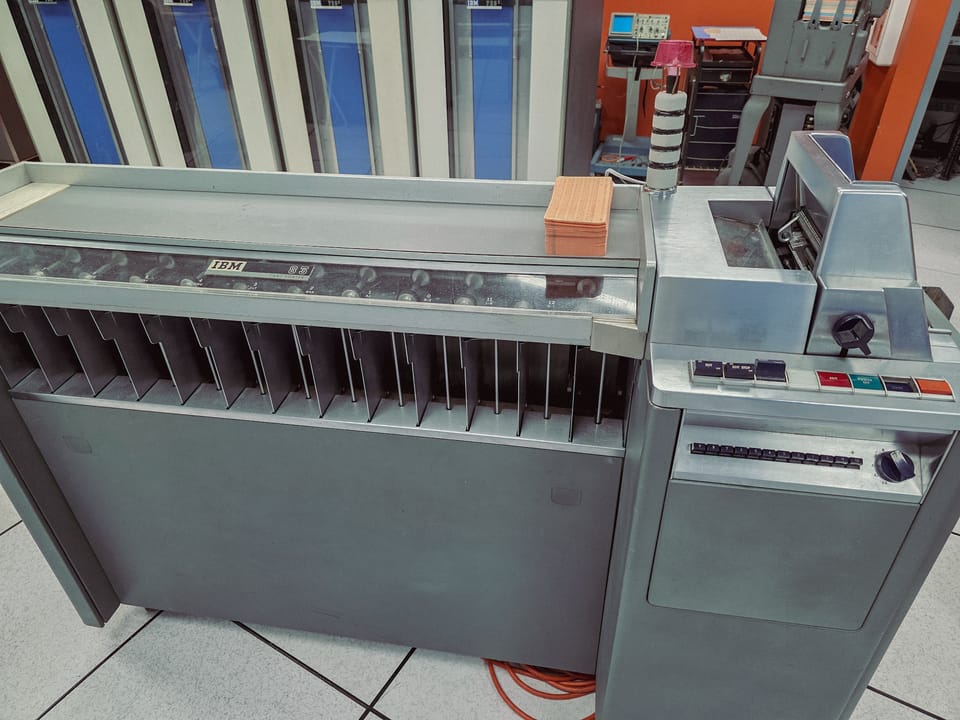
I took the photo above a couple of weeks ago at the Computer History Museum in Mountain View. It's an IBM 83 punched card sorter. It's a beautiful machine, and it's a reminder of how recently "programming" meant something physically and conceptually different from what it means today. We're in another one of those transitions right now.