
The CEO of Europe's largest software company just told you everything is fine. It isn't.
Yesterday, SAP's CEO wrote a ludicrous piece in the Financial Times ("Why the ‘SaaSpocalypse’ doomsayers are wrong"), in which he arguing that AI won't kill enterprise software.
He's right. It will kill enterprise software companies instead.
His message to investors and the industry: stay the course, this is just another platform shift, and value will migrate back to the application layer like it always does.
He's totally missed the point.
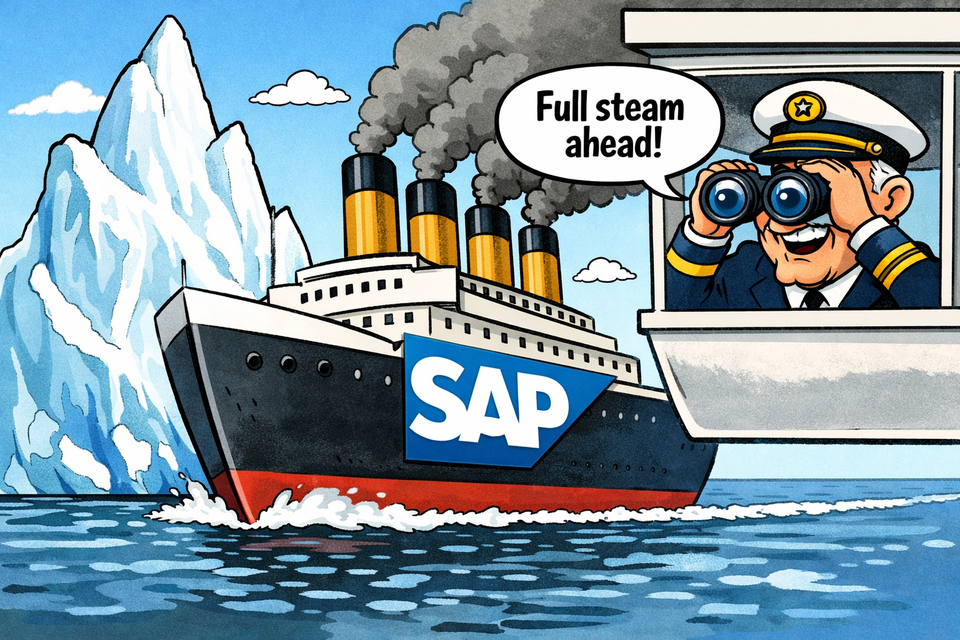
The threat to SAP (and to every large SaaS company) isn't that software disappears. It's that the fundamental economics of building software have permanently changed, and companies built on the old model are steaming towards an iceberg, refusing to accept reality.
He thinks this is like the cloud migration. It isn't even close.
Klein's central analogy is SAP's transition from on-premise to cloud. He writes:
"When SAP accelerated its transition to the cloud six years ago, the sceptics were just as loud."
He describes how moving from licence revenue to subscriptions meant short-term pain for long-term gain, and frames AI as the next chapter of the same story.
"Every major platform shift follows the same pattern. Early on, value accrues to the lowest layers of the stack... Over time, value migrates upward to the application layer, where technology translates into business outcomes."
This comparison reveals exactly how badly he misunderstands the situation.
The cloud migration was a change in delivery model. You were still selling the same software, to the same customers, built by the same people, with the same economics. The product didn't fundamentally change. The subscription model actually made revenue more predictable.
AI is a change in production economics. The cost to build competitive software has fallen off a cliff. That's not a platform shift. That's an existential threat to every company whose valuation is built on the assumption that what they've built is expensive to replicate.
The moat has evaporated
SAP has roughly 110,000 employees. Somewhere between 30,000 and 40,000 of those are in software development or technical roles. That workforce, and the institutional knowledge it represents, has been the company's core competitive advantage for decades. Nobody could replicate what SAP does because nobody could afford to assemble and maintain that kind of engineering operation.
That moat just evaporated.
We are already seeing experienced senior engineers produce in the order of 10x more output using AI-assisted development. Not in lab conditions. Not in demos. In production, shipping real code, today. That number is only going in one direction.
Think about what that means for a company like SAP. Their cost base, their hiring model, their entire organisational structure is built around the old economics of software development. The assumption that building enterprise software at scale requires tens of thousands of engineers working for decades.
Those assumptions will never be valid again.
Incumbency is now a liability
Klein leans hard on SAP's relationships and installed base as a source of strength. He writes (complete with em dashes 😉) about "persuading thousands of large enterprises — whose legacy systems run payroll, close the books and keep factories running — to move their mission-critical processes into a new model."
The irony is immense: SAP itself is a 110,000-person supertanker that now needs to completely transform how it builds software. Every process, every team structure, every hiring plan, every R&D budget - all of it was designed for a world that no longer exists.
Meanwhile, a new entrant can build a competing product with a fraction of the team, at a fraction of the cost, with none of the legacy baggage. They don't have 40,000 engineers to retrain or redeploy. They don't have decades of technical debt. They don't have an organisational culture built around the old way of doing things.
They just have a small team of exceptional engineers, AI tools, and a blank sheet of paper. And they don't have anywhere near the same level of cost to recover on their R&D, because they'll build it at a fraction of what it cost SAP.
Some leaders get it. Klein doesn't.
"Software is not being replaced. It is being asked to do far more."
While Klein is writing op-eds about how everything will be fine, other tech leaders are acting.
In February, Jack Dorsey (original Twitter co-founder) cut over 4,000 jobs at Block (roughly 40% of the company) explicitly because of AI. His memo to staff was blunt: "We no longer need the mass of people we once did to maintain our velocity."
Dorsey didn't frame this as a cost-cutting exercise, he framed it as the new reality: "A significantly smaller team, using the tools we're building, can do more and do it better. And intelligence tool capabilities are compounding faster every week."
You can agree or disagree with how Dorsey handled it. But at least he's looking at what's actually happening and responding. He's recognising that the economics have changed and restructuring accordingly.
When the barrier to entry collapses, the value of having already built something erodes fast. Your installed base buys you time, not safety. The companies that will thrive are the ones doing what Dorsey is doing — not what Klein is doing.
Writing an FT article about how everything is fine is not a strategy.