
The human layer, part 1: Brain fry
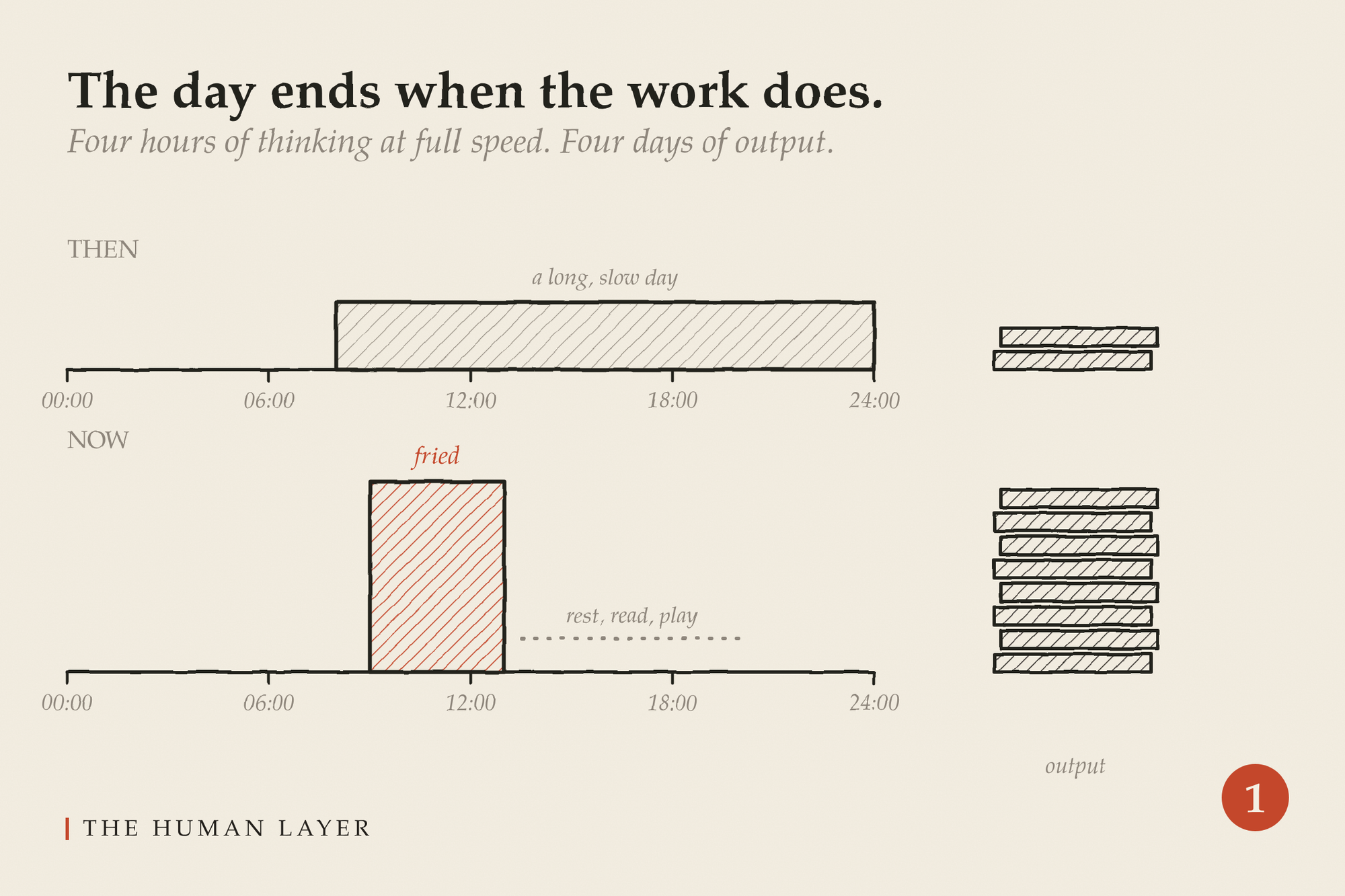
Four hours of building with AI tools leaves me as tired as a full day used to, and produces more. The hard part is stepping away without feeling like a fraud.
Introduction
Part 1: Brain fry (this post)
Part 2: The learning ratio
Part 3: The four modes of AI coding (and why you can only be in one)
Part 4: Delegate accountability, not tasks
A working day with AI tools is about four hours long, and I have had to make my peace with that.
When I started my last company, over 20 years ago, a twelve-hour day was normal and an eighteen-hour day was not unusual. I could do it week after week. Long hours were how you got more done, and the arithmetic was simple: effort went in, output came out, and the two scaled together.
I kept trying the same thing with AI tools this past year and it does not work. After four or five hours of serious building I am fried. If I push through to ten or twelve hours I sleep badly, and the next day is a write-off because I am still exhausted. The long day costs me the following one.
My head hurts
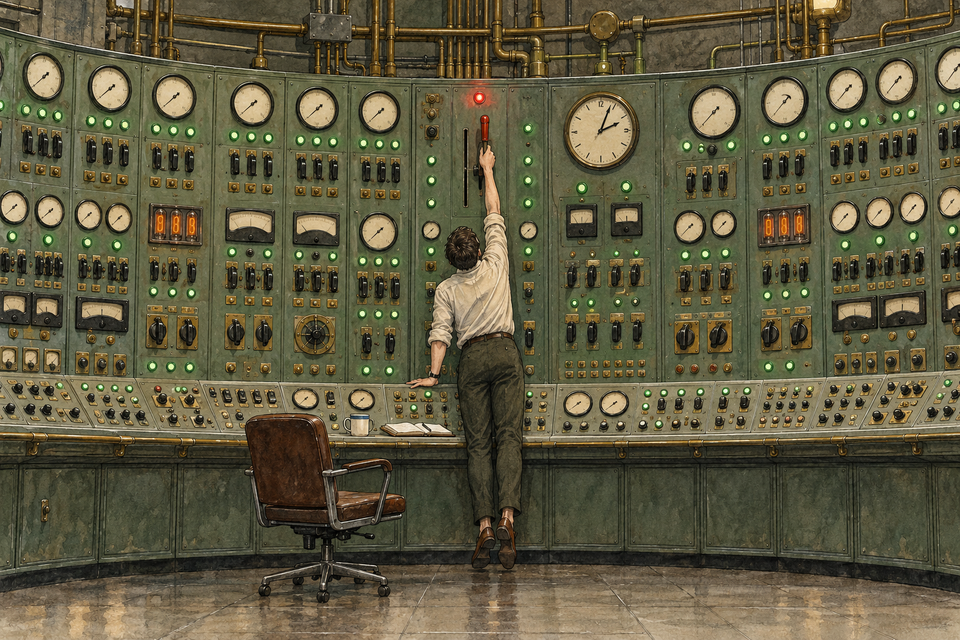
The reason is that the bottleneck has moved from the hands to the head. Typing (I'm generalising a bit here) used to set the pace, and typing is not that tiring. Now the tools type, and the pace is set by how fast I can think: decide, review, judge, correct, decide again. There is no idle time while the compiler runs or the boilerplate gets written. Every minute is a decision minute.
That is why it is so tiring, and also why it is so productive. In those four hours I cover ground that would have taken me three or four days five years ago. The output is there. It has just been compressed into a much shorter, much denser block of time, and the fatigue has been compressed with it.
The guilt
Stepping away at lunchtime, having done the equivalent of four days of work in 2020, feels weird. The instinct that says a day's work is eight hours at a desk is hard-earned, and it doesn't care about output. I have sat down at two in the afternoon, finished, and spent the rest of the day feeling vaguely guilty about it, which is absurd when you write it down.
I notice this more because I work alone. There is nobody to go home at the same time as, no office emptying out to signal that the day is over. The only signal is how I feel, and how I feel is fried and faintly ashamed of it.
Working in sprints
What I have settled on is shorter, more intense blocks of work with real rest between them. A morning of building. A proper break, away from the screen, long enough for my head to catch up with what just happened. Then, if there is anything left in the tank, a second, lighter block: reading, admin, planning, the playing about with new tools that keeps me current. Not a second sprint.
It turns out none of this is new. In the early 1990s Anders Ericsson studied violinists at a Berlin music academy and found that the best of them practised for about four hours a day, in intense blocks with rest between, while the weaker students put in closer to seven. The novelists he looked at wrote for about four hours in the morning and then stopped. Four hours of real thinking a day is what people have always been able to manage. The tools have just made all four of them count.
I also stopped measuring the day in hours. The question at the end of it is what did I achieve. By that measure, the four-hour day is the most productive working pattern I have ever had.
This fatigue is real and it is not going away, because the thing that causes it, being the slowest component in the loop, is exactly what makes the tools worth using. The adaptation is to accept it, plan around it, and stop apologising for a working day that ends when the work does.