
The human layer, part 4: Delegate accountability, not tasks
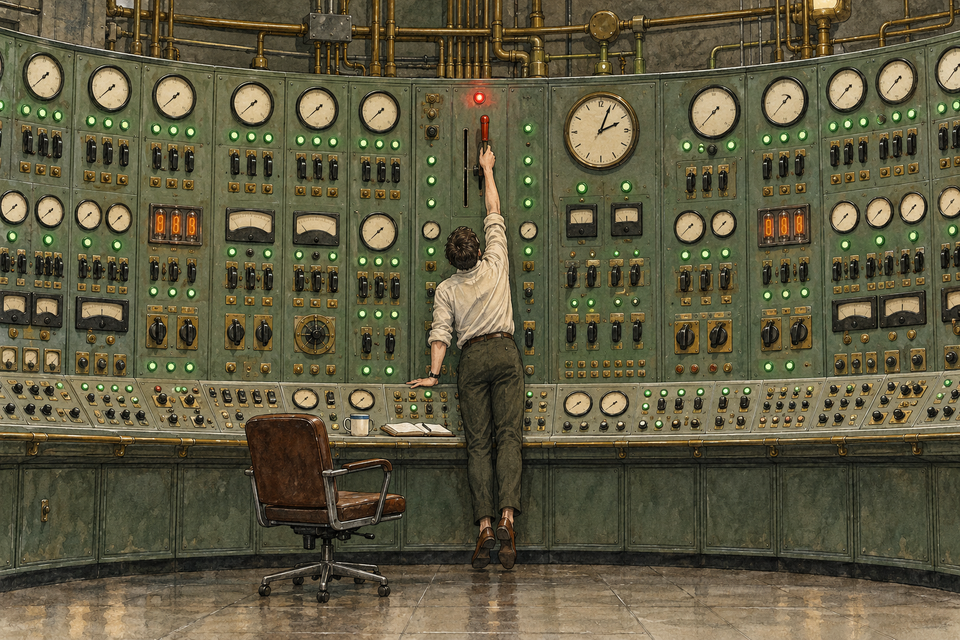
Who is responsible for this if I go on holiday? Not the tools; they are automations. When AI multiplies your reach, the thing you run out of first is accountability, and the people worth hiring are the ones who take ownership of a problem, not the ones who take tasks off your list.
Introduction
Part 1: Brain fry
Part 2: The learning ratio
Part 3: The four modes of AI coding (and why you can only be in one)
Part 4: Delegate accountability, not tasks (this post)
I no longer hire people to do things. I hire people so that I can stop thinking about things, and that has changed who I look for.
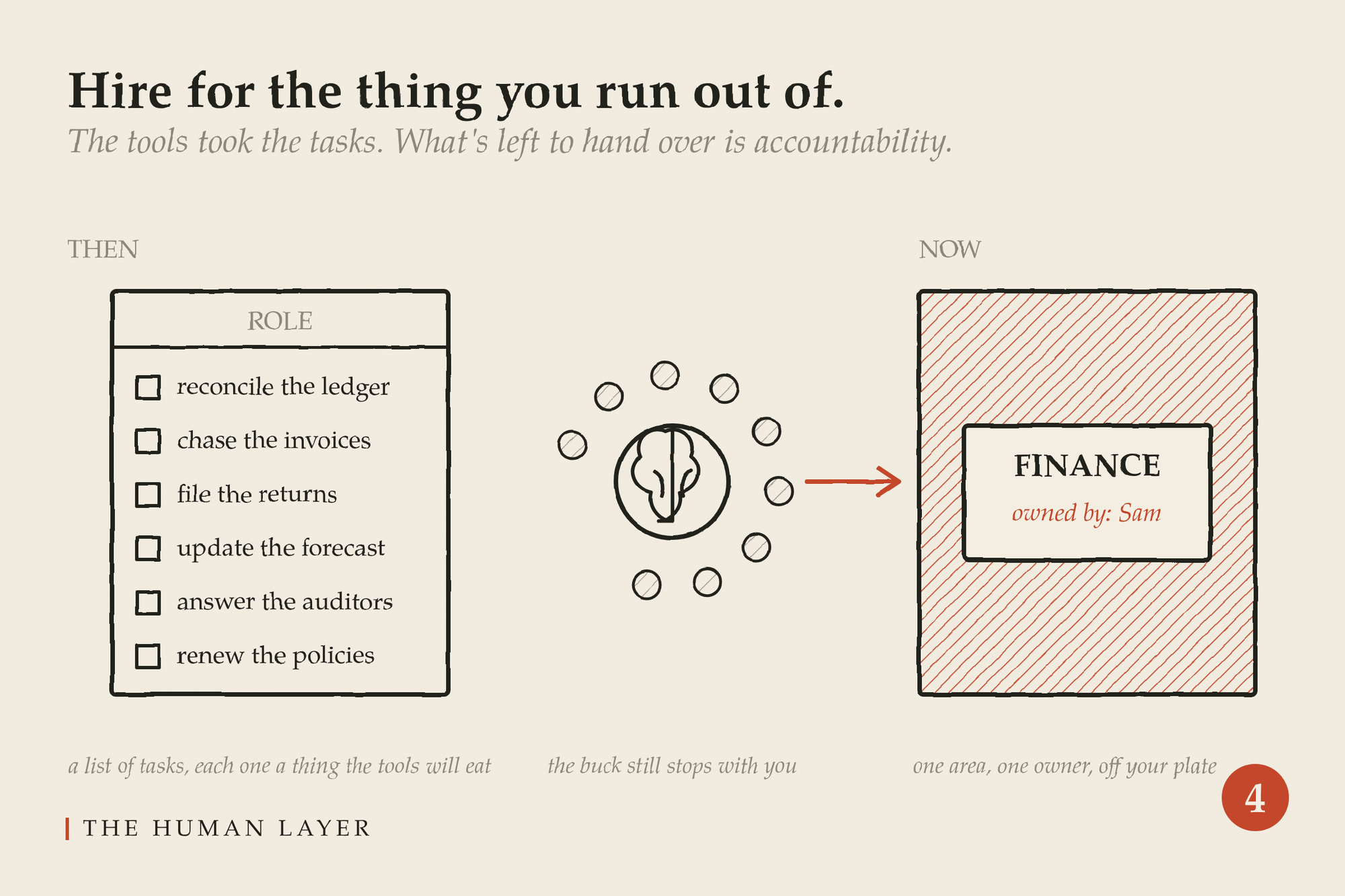
For most of my career, hiring started with a list of tasks. You worked out what needed doing, grouped the tasks into a role, wrote the role down, and found someone who could do it. The conversation was always the same: great, we can afford another person, what are they going to do?
That question has stopped making sense to me, and the previous three posts explain why.
The thing a solo founder runs out of
With AI tools I can be across far more of a business, at a greater depth than one person has ever been able to, for all of human history. It's wild. Finance, legal drafting, marketing copy, infrastructure, support, the product itself. The tools do a lot of the work, and they also embed a huge amount of the muscle memory within a task. What they cannot do is own it. I am still accountable for every one of those things. I still have to notice when something is wrong, decide what good looks like, and check that the machine did what I meant. I also can't go on holiday.
That supervision is what fries you. The first post in this series was about the fatigue of thinking at full speed; this is where the energy goes. Not into doing the tasks, which is largely automated now, but into holding twenty things in your head at once and being where the buck stops on all of them. The scarce resource in an AI-native business is accountability, and it is the one thing the tools give you more to spend, not less.
So the question when I think about hiring is no longer "who can do this?" The test I use now is simpler: who is responsible for this if I go on holiday? The tools cannot be. They are automations, and an automation that goes wrong on a Tuesday keeps going wrong until a person notices. If the answer is still me, I have not delegated anything, however much of the work the machines are doing. I expect the person I hire to use AI for the work. I expect them to build the automations and run them. What I am buying is a name other than mine against that area, so I can get on a plane.
Why hiring for tasks is now a bad bet
There are two problems with hiring for a list of tasks, and both have got worse.
The first is that the tasks you're hiring for might not exist in two years. Tools improve, a task gets absorbed, and the role you hired for is hollowed out from the inside. The World Economic Forum expects 39% of workers' core skills to change by 2030. If you wrote a job description around today's tasks, you are hiring for a role with a built-in expiry date.
The second is that it pigeonholes people, or people pigeonhole themselves. Hire someone to do finance tasks and they will see themselves as the finance person, their career as a finance career, and everything outside that lane as somebody else's problem. That is precisely the attitude an AI-native business cannot afford, because the lanes themselves keep moving.
Shopify's Tobi Lütke made a version of this point in his memo to staff last year: before asking for headcount, teams must show why they cannot get the work done with AI, and AI use is a baseline expectation of everyone. If the tasks can be done by the tools, the only reason left to hire a person is ownership.
Amazon's Andy Jassy said the same thing from the other side in June 2025: generative AI will "reduce our total corporate workforce", and staff should work out how to "get more done with scrappier teams". Scrappier teams are teams of owners. You cannot run a lean team on people who wait to be told which tasks are theirs.
The future belongs to generalists
Put those together and the shape of the person changes. Nobody needs a specialist in a set of tasks that the tools will perform. What you need is someone who can be handed an area of the business, work out what good looks like, build or buy the tools to run it, and tell you when something needs your attention. A generalist, in other words, with the judgement to own things rather than the skills to do things.
That is a different profile, and it is much harder to hire for, because the qualities are about how someone works rather than what they know. The ones I look for are the ones that make a person resilient to everything else in this series:
- Self-aware. They notice when they are in the wrong mode, when they are fried, when they are reading too little or too much and whether they are falling behind. They do not need me to notice it for them.
- Curious. They want to know how the new thing works, and they go and find out without being sent. Curiosity is what keeps a generalist current when the ground moves constantly.
- Excited by change. Not tolerant of it. Excited. The tools they are using in January will not be the tools they are using in June, and that has to feel normal rather than threatening.
- Self-motivated. The expectation is that one person with these tools can get an enormous amount done on their own. That only works if they are the kind of person who gets on with it.
The WEF's own list of the skills employers expect to matter most by 2030 is strikingly close: resilience, flexibility and agility, curiosity and lifelong learning, motivation and self-awareness. None of them is a task. All of them are about how a person carries themselves through change.
What this means in practice
When I write a role now, I write it as an area and an outcome rather than a task list. "Own our infrastructure" rather than six bullet points about servers and documentation.
Most surprisingly, is that most times I start this process, I realise I shouldn't be hiring anyone at all. My old instincts are misfiring, and actually what it needs is some Mode 3 scaffolding.
The tools can now perform most of the tasks. What is left to delegate is accountability, and that is a much better thing to hire for.